
Spoken words
A child may share ideas in words, sounds, short phrases or repeated language.
What may help
Listen for the meaning. Use calm, clear phrases and leave time for a response.
Words are only one way children connect. Gestures, pictures, movement and communication tools all help children share what matters. Discover gentle ways to help your child feel heard.

Some children speak easily, some use a few words, and others use gestures, pictures or technology. Needs and strengths differ. The aim is meaningful connection, participation and choice—not making every child communicate in the same way.
Communication differences alone are not an autism diagnosis.
A child might use several forms of communication in a single day.
A child may share ideas in words, sounds, short phrases or repeated language.
Listen for the meaning. Use calm, clear phrases and leave time for a response.
Pointing, reaching, body movement and expressions can tell us a great deal.
Respond to gestures and preferences; eye contact is not required for connection.
Photos, objects, picture cards and written choices may help explain needs or what happens next.
Try a familiar picture or a two-step routine. Keep what helps your child.
Some children use signs, picture systems, typing or speech-generating devices.
A speech-language professional can help tailor supports. AAC is not a last resort.
Choose just one idea that feels comfortable. Every child moves at their own pace.
Join a preferred activity. Describe what you notice, rather than asking question after question.
Use a short phrase, gesture or picture and keep a predictable routine.
Pause and allow a gesture, sound, word, glance or device response.
Show two activities or foods, and respect how your child communicates their preference.
Celebrate communication without pressuring a child to perform or make eye contact.
A simple now → next routine can make transitions easier for some children. Use gestures, words, familiar objects or pictures that are meaningful to your child.
This is an example, not a prescribed therapy exercise. If it does not help, choose a different way to communicate.
Augmentative and alternative communication (AAC) includes signs, gestures, picture boards, typing and speech-generating devices. These can support or replace speech when useful.
AAC does not mean giving up on speech. It should reflect a child’s needs and preferences. A qualified speech-language professional can help families choose and use an appropriate approach.
Explore ASHA’s AAC guidanceResearch summarised by ASHA and the American Academy of Pediatrics does not show that AAC prevents speech development. AAC can support communication while speech develops. A qualified speech-language professional can help choose suitable options.
No. Eye contact is not a requirement for listening. Join your child’s attention and give them a comfortable way to participate.
Repetition may serve several purposes. Notice the context and what your child seems to be sharing. A speech-language professional can help understand their individual communication profile.
No. Communication or developmental concerns can be discussed whenever they appear. A clinician may advise hearing assessment, speech-language review or a broader developmental evaluation.
Use the languages your family naturally speaks. Tell your child’s clinician which languages they hear and use so any evaluation and supports reflect your home environment.
When to ask for help: Speak with a paediatrician if communication differences affect everyday participation, you suspect hearing difficulty, or you are concerned about development. Loss of previously acquired language or other skills warrants prompt assessment. This page is not a screening or diagnosis.
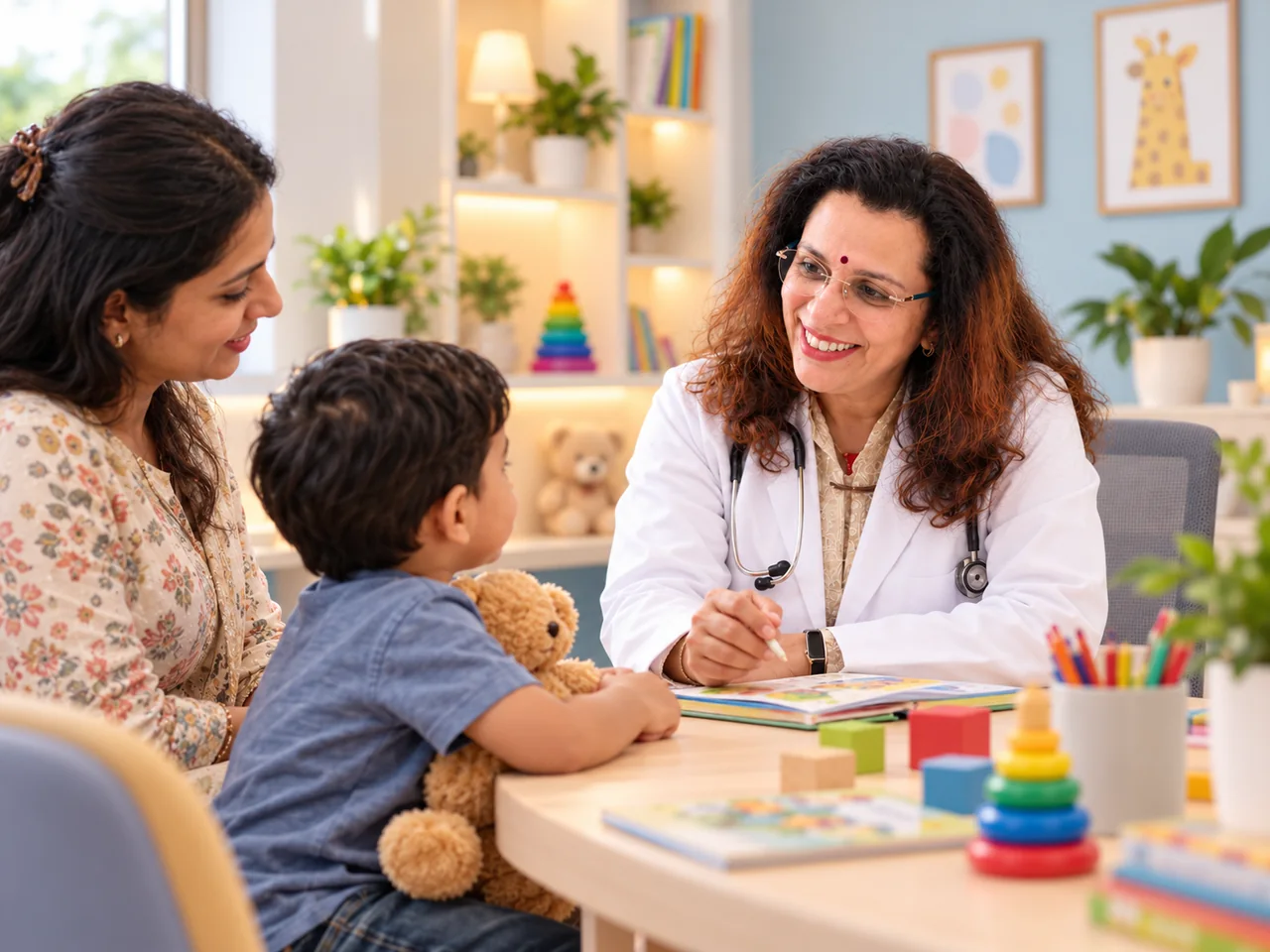
Bring your observations to Dr Kanak’s team at Mamta Hospital. Ask about evaluation and referrals when appropriate. An appointment or specialist therapy is not guaranteed through this website.
Educational information only. Individual decisions should be made with an appropriate health professional.
Plan a visit with Dr Kanak at Mamta Hospital, Raipur.