
Bright minds can need support with attention.
Children with strong reasoning skills can also experience ADHD. Let us recognise their strengths while giving them the structure and understanding they need.

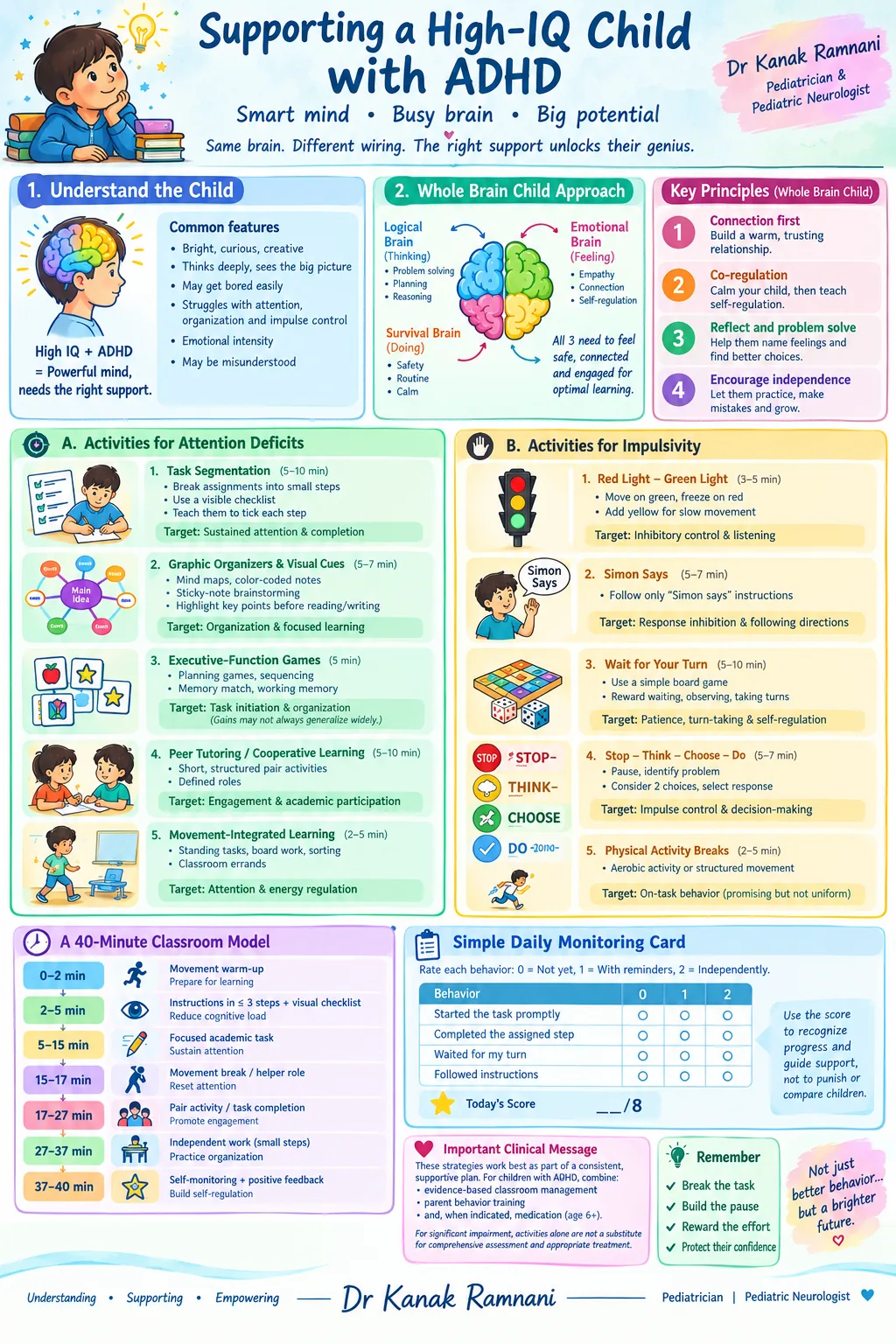
Five gentle, practical starting points
Break one task into steps
Use a 3-step checklist. Let the child tick off one achievable action at a time.
Make ideas visible
Try mind maps, coloured notes and one key point per box instead of long instructions.
Practise starting and switching
Use short planning games and a predictable countdown before changing activities.
Build connection and turns
Try cooperative games, gentle redirection and specific praise for turn-taking.
Make room to move
Offer a brief movement break when it helps the child return to learning.
Support works best when it fits the child
For families
Notice patterns in sleep, activity, frustration and learning. Praise a specific effort, choose one goal and share what works with school.
For teachers
Give clear, short instructions; offer an organisational tool and a movement break when needed; use constructive feedback with the child.
For the care team
Discuss the child's functioning across settings, coexisting concerns and whether assessment or an individual management plan may help.
Open optional illustrated worksheet: ADHD support infographic
Every child deserves to feel understood.
Bring your child's school observations and your concerns to Dr Kanak's team at Mamta Hospital.
Guidance behind these ideas
These are independent clinical and public-health resources. Classroom activities are supportive techniques, not an ADHD diagnosis or a substitute for individualized care.
Let’s take the next step together.
Plan a visit with Dr Kanak at Mamta Hospital, Raipur.